
Raising Hope for the 2026 Monarch Migration
Raise The Migration 2026 Results
Raise The Migration is an annual North American challenge to raise monarch butterflies to release for fall’s annual 2026 monarch migration. The time has come to share your raising experience and raise it forward…

The raising season is coming to an end, so we’d love to hear how many butterflies you released for fall’s annual 2026 monarch migration…but more importantly, what lessons you’ve learned through this amazing raising experience?
If you’ve still got some raising to do, raise on! But please post in the comment box at the bottom of this page after you’ve released your last butterfly.
Every year, I start Raise The Migration in July, but monarchs raised at that time aren’t actually migration generation butterflies…they’re the parents to that amazing generation of travelers.
There’s no way to tell whether butterflies will mate or migrate, but one telltale sign of a migration generation butterfly is its size, which is dependent on how much milkweed the caterpillar eats. The first super-sized caterpillars start to form chrysalides around the first week of September in our northern region…
In the garden, you can tell non-migratory butterflies by their worn out wings. Non-migratory males are also more aggressive, chasing off potential competition while seeking out female companionship…migratory monarchs are in sexual diapause and only interested in stocking up on nectar for the long journey ahead.
So how did our Migration Monarchs fare this season and what lessons did we learn raising forward? Find out below, but first…
===========================================================================================
Here are Raise the Migration results from the past thirteen seasons:
2025- 93% Survival Rate
2024- 100% Survival Rate
2023– 89% Survival Rate
2022- 100% Survival Rate
2021- 86% Survival Rate
2020- 82% survival rate
2019- 81% survival rate
2018- 93% survival rate
2017- 100% survival rate
2016- 96% survival rate
2015- 96% survival rate
2014- 90% survival rate
2013- 100% survival rate
As you can see from the results, this raising system is consistently producing healthy monarchs to help improve our raising experience while also helping to support the struggling monarch population.
Raise The Migration 2026 Results
In 2026, we raised 19 migration generation monarchs that were released starting in late August.
Here’s what happened with our 19 monarch guests this season…
Unexplained Egg Deaths
For the first time in the history, we lost an egg that wasn’t parasitized. We brought this egg in around August 31st and it looked like a perfect specimen. Another egg we brought in the same day hatched on September 1st.
We kept the unhatched egg in a sealed food container for two weeks and checked it daily. The egg never darkened, but by day 14 it started to look like it was imploding so we discarded it. There was no visible sign of damage to the egg when we examined it with a magnifying glass. It seems unlikely the egg was unfertilized because we have had many monarchs in the region. This will be one of my all time great mysteries from Raise The Migration. 🕵🏽♂️
Caterpillar Escapes
Zero issues this year….they are 100% secure in their mesh cages.
Unexplained Caterpillar Deaths
Thankfully none.
Caterpillar Diseases and Parasites
Zero problems this season
Accidental Deaths
An accident-free raising season in 2026 😊
Chrysalis Problems
ZERO
Butterfly Eclosure Issues
All butterflies eclosed, expanded, and dried without issue.
Final Results
So how many monarchs survived to reach butterhood?
18 healthy butterflies were released from September 8 to October 7th
0 accidental deaths
0 disease or parasite issues
1 unexplained deaths
0 chrysalis problems
13 healthy males
5 healthy females
95% survival rate
Lessons Learned in 2026
We raised both indoors and out this year, but the lessons this year are mainly from our outdoor setup
Bungee Cords: I use these to keep the tarp over the outer cage to prevent rain from taking down chrysalides in the inner cage. I had been using one bungee on each side, but that still allowed the tarp to partially blow off the cage when there were strong winds. If you connect two bungees on each side (one by each corner of the cage) your tarp will never come loose exposing monarchs to extreme wind and heavy rain.
How to Encourage Monarchs to Pupate on the cage roof?
This is the preferred way for monarchs to pupate because it means you won’t have to worry about rehanging if leaves don’t last through the chrysalis stage. Roof pupation should be the goal whether you’re raising indoors or out.
There are three ways to encourage this:
- More space– spread out the milkweed so it doesn’t create a dense forest effect in the cage. (accomplish this by raising fewer monarchs or using a larger cage)
- Leaves touching wall– make sure milkweed is touching a mesh wall so the caterpillar can easily crawl over to it
- Towel/cloth over cage roof– I’d recommend something in a nature shade of green that blocks the direct sunlight. Placing green handles overs the cage roof is less effective in an outdoor setting.
However, the monarch caterpillars aren’t always cooperative, even if you take the precautions listed above. If you need to rehang, here are more ideas to make this process easier…
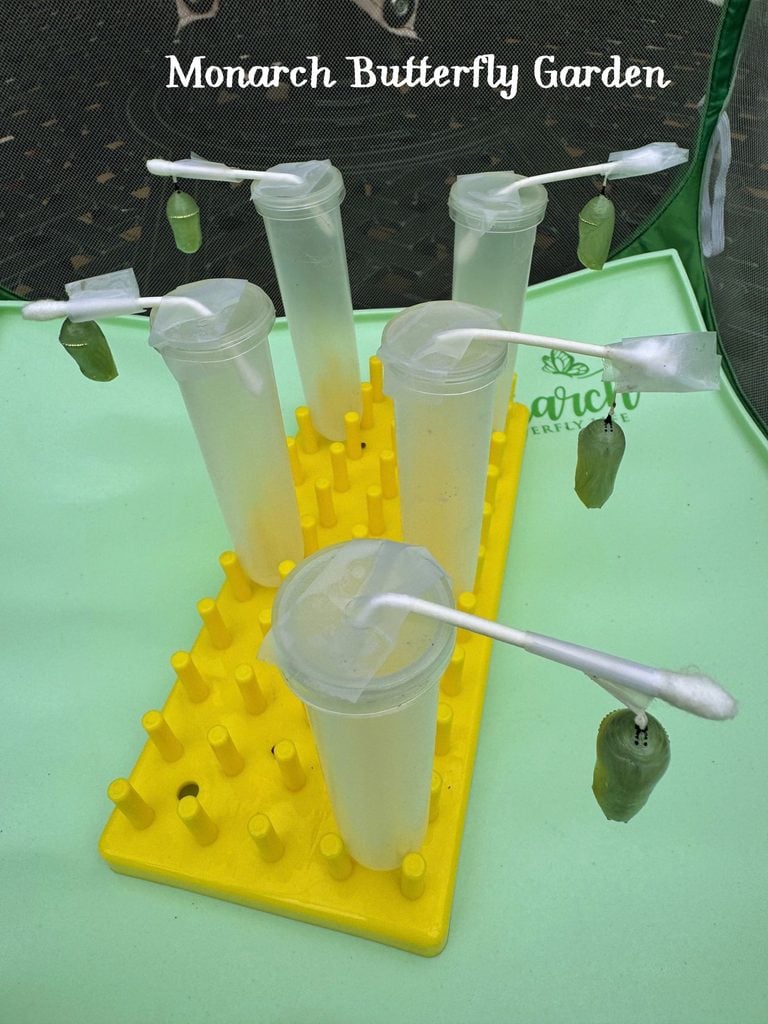
Chrysalis Removal: When rehanging chrysalides (all of these were removed from leaves) use a needle to loosen the thread first. Only spray water to loosen the thread if you can’t loosen with the needle first. Spraying with water degrades the stickiness of their silk and can make them more difficult to rehang:
Migration Memories 2026
Multiple migration generation monarchs were missing white spots on the upper section of their forewings. My guess is this slight variation (I’ve noticed over the years) helps monarchs warm their flight muscles faster in cool fall weather that is common at the end of the season. If you’re in located in the northern US or Canada, have you noticed this before?

For the final 5 butterflies released starting in late September, they all had one thing in common…when they were released they immediately shot up to the sky and flew south:
Release Video Coming Soon
The final two butterflies (1 male and 1 female) exited south just as quickly after they were released:
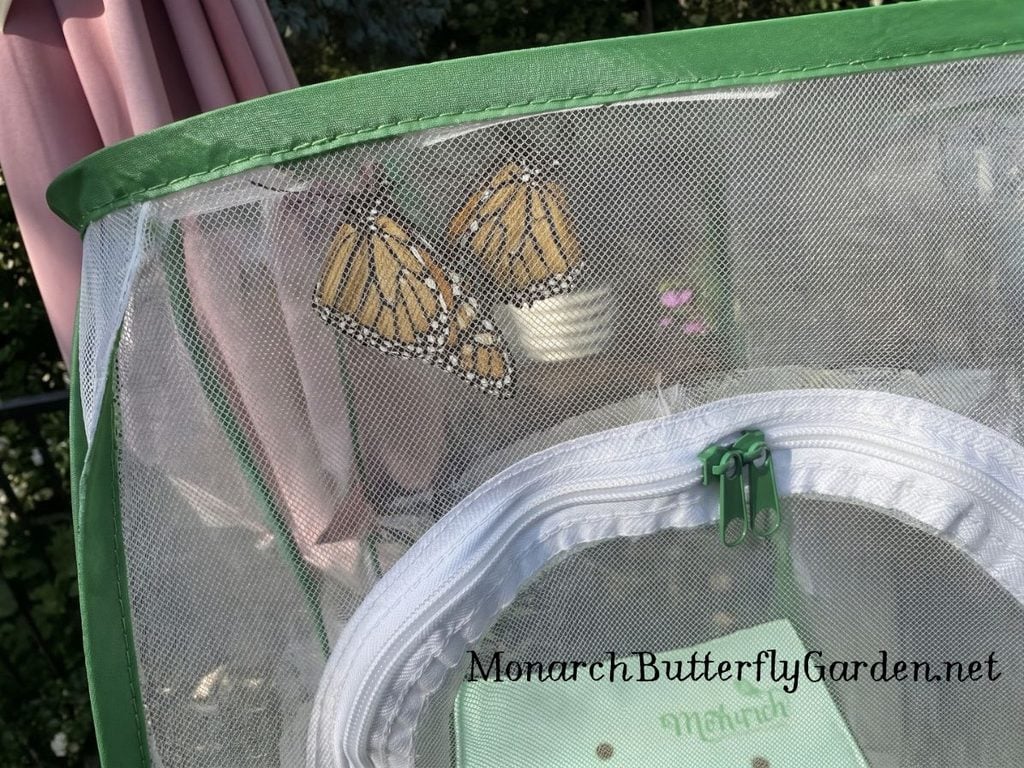
And that marks the end of another successful season raising monarchs….
==============================================
I hope you enjoyed reading about my Raise The Migration ’26 results and lessons learned raising monarchs through the butterfly life cycle .
And now, we’d love to hear about your experience…
Share Your Results?! ✍️
Please share your results at the bottom of this page and let us know how many monarchs you released to help boost the struggling monarch population…remember to include your location.
More importantly, please share the most valuable lesson(s) you learned about raising monarch butterflies, that you believe can help others in the community raising forward.
Thank you for helping to Raise the Migration in 2026




I live near Fargo, ND. I had a very successful 2026 season releasing 243 monarchs (109 females and 134 males). My first sighting of milkweed in my yard was May 21 and my first monarch sighting in my yard was May 30th, over a month earlier than last year. I felt like t-fly issues were down this year. Also saw monarch caterpillars on every milkweed variety in my yard including whorled milkweed, tall green milkweed and even honeyvine milkweed! On a sad note, did not see many bumblebees in my yard or elsewhere. On an exciting note, I found black swallowtail caterpillars on dill in my yard. I’ve never seen a black swallowtail but one must have visited.
Plainfield, IL – 35 miles SW of Chicago-
With all the spring rain this year common milkweed took over my butterfly/bird garden. I successfully released 192 monarchs, 89 males & 103 females, last ones being released on 10/2. Unfortunately 3 casualties – 1 chrysalis I accidentally stuck with a pin that leaked out, one misshapen and partly blackened from what looked like a caterpillar attack, and one female monarch that flew into me and disappeared – only to be found stuck in webs in the patio umbrella stand 3 days later. One 3rd in star cat died from what appeared to be anal prolapse and I lost 3 or 4 hatchling first instars. All cats were raised inside from eggs except for a few first or second instars, 2 fifth instars and one chrysalis found outside which all eclosed successfully. All in all a good year with noticeably less tachnid flies hovering around and only about 3.6% losses. I learned not to give up on chrysalides formed on leaves that had fallen off while in floral tubes. I hung them and 2 eclosed and flew. And, one chrysalis that appeared to have a “healed” even circular separation all around just under the cremaster eclosed and flew! I also raised 21 American Ladies and 4 black swallowtails that overwintered in my garage eclosed in early May, 1 female and 3 males.
Last year we released a total of 54 monarchs. This year we released only 18. Didn’t find the volume of cats like the year before at all. But, we did find 8 eggs (but because of moving them around in tubs, etc.) maybe one or two of them died. But raising them from eggs was wonderful. Hoping for a better 2027.
I live near Westerville Ohio, and began my Monarch Butterfly hobby in 2019, the year I retired. My 2026 Monarch journey began early, with my first sightings in early June. In previous years, I had never seen a Monarch before August, so this was an exciting change! Over the following months, I collected a total of 14 caterpillars and found 10 eggs. This was the first year I successfully found, identified, collected, and nurtured eggs, all of which I attribute to the guidance and knowledge shared by Tony in his newsletter posts.
Out of a total of 24 caterpillars this year, I successfully raised and released 21 monarchs-14 females and 7 males. I sadly lost 3 along the way. One was eaten by another caterpillar, another fell and never survived despite my carefully placing it on a milkweed leaf, and the last was a small caterpillar I found in late September. I believe this last one simply ran out of time. It didn’t eat well, and when it formed its chrysalis the other day, it was malformed and began to leak. With a heavy heart, I froze it and buried it in a pot of flowers. My equipment consists of 2 tall screened popup butterfly enclosures with 2 sets of floral tubes which are keep in a covered sunporch. This year’s survival rate: 87.5%. My yard has 3 areas of common milkweed, several areas of assorted perennials that I continue to add to each year, and some annuals especially lots of zinnias plus a vegetable garden.
It was a fabulous season for monarchs in Sioux Falls, South Dakota! I raised and released 111 healthy, strong monarchs this year with 41 of them being migrators. This was my 9th year working with monarchs. The first monarch I released was on June 19 and the final was on October 6th. I have 32 of Tony’s Monarch Life cages and found I was washing/disinfecting cages each night to make them ready for the next resident. I know you can have more than one caterpillar in each cage but I have always kept it to one calling it their own little “Hilton”. I had to relocate 85% of my chrysalises to the top of the cages due to poor choices made by caterpillars (pegs, tubes, leaves). I have a cool process that has been successful over all these years involving a stick, unscented dental floss and two black metal clamps. I keep my butterfly room the same temperature as the outdoors by leaving the window open. I try to keep the humidity above 50%. This environment makes 2 X/day cage cleaning a little harder. I did have one loss due to tachinid fly parasite which was a first time for me. I have 13 milkweed plants but had some stressfull mornings finding eggless, strong stemmed milkweed for those bigger cats. A sad discovery, as I was cleaning out my end of season milkweed plants, I closely inspected them for spent chrysalises and found zero. It just made it. even more clear that what we are all doing to raise the migration is so very important and rewarding.
Here in East Aurora, NY we had a nice summer. I found many eggs on the tropical milkweed that was planted along with native big leaf milkweek. Eggs and cats were found in early June compared to last year’s July. Successfully raised 186 healthy, beautiful butterflies. (MBA) Monarch butterfly addiction for sure. Kept me very busy all summer long cleaning and restocking cages which I kept in the house. Lost some along the way due to parasites. I may try to cut back some next year (Yeah, right) Kept everything disinfected daily by cleaning tools, poo-poo platers, floral vials and stands, and washing my hands frequently with Dial antibacterial soap. I try to never touch the cats. Late Sept. early Oct. I was struggling to find decent leaves to feed and had to turn the heat on in the back room to keep cats and chrysalis warm enough as day and night temps were low. Also, there were many fewer nectar plants to feed on once released. The spring planted curly parsley had two swallowtail cats enjoying the greens! I’ll plant parsley again next year along with more zinias and mexican sunflowers for the late emerging monarchs.
Tony July storms wiped out all of our milkweed plants, bent then over to the ground and we had no Monarchs come to our garden this year. Leason Learned will be next year to stake plants so they can survive storms.
Greetings from Northern NJ! It was a slow season for me this year. My first female showed up so late, 7/22/2026. We had a very cold spring with late snow. Maybe that was the cause? Lots of heavy rain all summer too. I released 49 this year. 19 Males and 30 Females. I was surprised how my females outweighed the males. I have been doing this since 2018 and they have always been closer in count.. Here are two experiences for 2026.
Chomper, a female was released 9/19/26. She would not stop eating. She was, what I thought, would be my last for the season.(always an emotional attachment) I packed her in the car in a baby cube with plenty of common & swamp milkweed and made the way to New Hampshire for my nephew’s wedding on Labor Day W/E. First time taking a Fat Cat on a road trip!
Upon my return. I found 6 additional Fat Cats of varying large sizes! Pre-trip my hubby said “stop looking we aren’t taking them all on a road trip. They will be here when you get back.” LOL. Those babies formed some of the largest chrysalis yet. To my dismay tho, they were all due to eclose during for the 2026 Nor’Easter! And they sure did. I had 6 beautiful butterflies relocated into smaller habitats each time two eclosed. I did this so they would not knock a new baby off it’s empty chrysalis with wing exercising. Can’t have crowding. Great … now what? It was windy with sheets of rain stalled over northern NJ for DAYS!!! The first two that had eclosed were held back for a total of 3 days. I was worried. They all had huge fresh bouquets of cut annuals in their habitats, and were NOT interested. I was surprised how strong they all were when ultimately released! Truly amazing magical beings, our Monarchs are.
Til next year! And a big thank you to Tony for all you do to keep us educated. Couldn’t do it without you.
Released 30 monarchs this year—17 females, 12 males, 1 un-id.
I live just south of London, Ontario and have raised eggs and cats successfully since 2020. This year despite the hot summer I released my greatest number: over 25 adults-so rewarding.! I had my first adult butterfly sighting at the end of May, which is usually far too early for most Monarchs in this area. It wasn’t until the first week in July before I started seeing this years cats on my swamp and common milkweed with 75% of the adults being male. By the first week in Sept I had resigned myself to waiting for next year’s crop. However I had a very welcome discovery 10 days ago to find a 1-1/2″ cat on a sad, dying leaf. I quickly rescued him from the outdoors and provided him with some juicy green leaves which he happily munched on for about a week before going into his chrysalis. Now I look forward to his butterfly stage and know this is definitely my last one for 2026.
This summer we had loads of monarch butterflies here in our remote area just south of Lake Superior. (Last year we had very few.) I raised 47 butterflies from eggs with no losses. Most of them were migrators. Common milkweed has taken over way too much of my perennial flower bed, but oh, well. The monarchs have now all left here, which is good because we have almost frosted here and they’ve had hard frosts inland.
Good morning my name is Bill Marion. I live in North Carolina 2025. I I had 60 monarchs this year. I had five I don’t know why, but I did not have very many monarchs this year and this is the number of butterflies that I released.
Greetings all, I live on the northwest shore of Lake Erie here in Lorain Ohio. I recorded my 1st monarch arrival May 4th which was 2 months earlier then normal as the migration goes here locally. I did not have another visit until early July. I am happy to report the safe release of 54 monarchs this migration.
Released my final 3 Monarchs on September 23rd. My total was 691 for 2026. Here in Central Florida the extreme heat this Summer was challenging and I had a few chrysalides dry out. It was fun sharing releases with friends and neighbors, especially the kids. Every year brings more knowledge. Thank you Tony and posters!
May granddaughter and I raised 20 Monarchs this year. All caterpillars were collected on my Waystation certified property in rural Carp, Ontario, Canada. Most of the caterpillars were found on Swamp Milkweed with a few specimens found on Common Milkweed. All specimens were large, brightly coloured and had no issues forming into chrysalids. They all emerged as healthy butterflies. There were double the number of females emerging compared to males. I watched Monarchs flying around here in small numbers throughout the summer. They loved my pollinator gardens and gravitated to a variety of flowers but particularly enjoyed nectaring on my Ageratum houstoniamum.
I released 12 females and 11 males. I started collecting cats in June and they were all females until August then half half, the last 6 were all male. Kinda different. I had 4 die from tachynid fly, 5 died for unknown reason and 4 were unable to fully form their chrysalis. First time for that. So 1/3 of my cats died for one reason or another, all organic yard but im sure my little town sprays the mosquitoes frequently and I’m surrounded by corn fields. I grew plenty of zinnias but first year no monarchs visiting my flowers on the way south. Did get video of mating monarchs in my tree though in August. Lots of swallowtail butterflies especially in the Tall Trees. This was my third year and I was finally able to spot the eggs and tiny cats all on the tender new growth in the lawn. Milkweed is so invasive. I will prune my Milkweed next year to encourage new growth later. My Milkweed was finished blooming before a single butterfly showed up. But new people are excited to help the monarchs next year after my friend showed others and posted videos, and have requested pods for their yards.
On September 18th we released the last 2 Monarchs from our 2026 project. (our 9th year)
A total of 25 Monarchs have been released. (11 Males and 14 Females) Our numbers are low compared to others, but no less exciting every year.
In the past I’ve had problems with Common Milkweed staying fresh for the August/September caterpillars, which we see more of later than in the early summer. I read where you can trim the milkweed back in June for it to grow fresher for the later months, so I only trimmed a few back to see how it would go, but first made sure no eggs or caterpillars were on the part I was cutting off. It actually worked. The stalks I trimmed are still fresh, whereas the others have really died off.
It will be hard to break the habit of checking the Monarch enclosures the first thing every morning to see what activity is going on. Looking forward to 2027 which will be our 10th year.
Diane A.
Dauphin county, PA
Released 103 monarch butterflies. Kitchener Ontario.
Surviving rate was 91%. I am looking to pickup monarch eggs very early and no later than first week of August because in September is heavy wind and rain 🌧️. An other reason to pick up eggs earlier is the freshness of the milkweed . This year could pick up eggs 2 weeks early in June 24 but at the end of July when supposed to be the peak hardly could find any. It was the Canadian forest fire making a dark orange sky in my area maybe. For 10 years made a good milkweed plantation in my neighborhood but now is time to pick up the seeds and move them because the tree are growing and is to much shade. The size of my monarch are medium big but at the end of season can see some giant monarch in my garden. Could somebody tell me how to get giant monarch.
Regards Tony Brancusi
I live in south central PA. I have been raising/releasing monarchs since 2020. I released 100 monarchs that year using the castle cages. I had 7 milkweed plants this year, tropicals and hairy balls. The cats are exposed to the wind, rains and sunshine. I monitor the cats as they grow and eat the leaves and buds. My first batch of cats consisted of 36 which moved around the garden creating their chrysalis. It was exciting finding their chrysalis and watching their progress into the beautiful Monarch. My second batch consisted of 36 more cats. Since the first monarchs arrived in early August, they have been busy producing eggs. This second batch had thunderstorms and predators to deal with. The last 19 cats were taken to the nearby community park where common milkweed were abundant. No fear of spraying there. Now, sitting in my back yard, I discover 3 more cats. Oh dear.
Had six Monarchs emerge this summer, here on Long Island, New York. I create a habitat out of a shoebox and clear wrap with paper towels in the base. Easy to lift the Saran Wrap and replace the paper towels daily.
I raised 64 butterflies from the egg stage in Delaware. I first saw a Monarch in late June and even though I saw VERY few Monarchs, they were out there laying eggs. All but one emerged from the chrysalis normal and fully developed.
Felice Howell
I live in southeast Michigan, and have had a very bad year. I was unaware that mice would eat caterpillars, as well as chrysalis. I hope to have better luck in 2027.
I have about 20 common milkweed plants in 3 areas of my yard in Wilmette, IL I have had a very discouraging year and didn’t have any to release. Past 8 years I have indoor raised and released 25-35 monarchs. This year I brought in fresh recently laid
eggs. For the eggs I find and don’t bring in I tear the tip of the leaf so I know that at have already seen, but not brought in. I left at least 75-100 eggs out for nature to take care of. I never saw any caterpillars larger than 2nd stage outside. I brought in around 25 eggs, fed them fresh young milkweed leaves etc., most made it to the 2nd stage. Only a few made it to being large enough to form a Chrysalis. those either died making the chrysalis, or turned black while hanging.
No pesticides are used in our yard, and no spraying by neighbors or village. With cool months in April and May they didn’t arrive until June. Mid June we had nasty smoke and hot weather which may have factored in.
I have around 2 dozen milkweed pods to share this fall – but don’t know if I should in case there is a problem in the milkweed. I am done for this year and will just pray for better results next year.
Since we live in south Florida, we have a longer Monarch season than most areas. We’ve been doing this for over 5 years now and we average about 50 successful monarchs every season. I had to purchase a second cage because I had so many chrysalis’ and cats. This year I discovered that any milkweed I purchased from our new local nursery needed to sit inside our porch enclosure for at least a week before offering it to any hungry cats. Why? It turns out there are eggs that I didn’t notice upon initial inspection. After about a week I’ll see tiny cats on the plant and protect them from any adults I have currently in the cages. I use to harvest eggs and small cats from the outdoor garden but using this new method I have less loss from parasites and diseases. I think we only lost between 3-5 this year so we’re happy about that. I still have 7 chrysalis’ right now and another 6 hungry cats so the count continues. Thank you for the informative newsletter.
My first year ever and I am a beginner in Garfield, New Jersey. I no longer use any pesticides on grass or anywhere on property. I planted swamp milkweed. Seedlings dried out and died, but gallon containers survived and thrived. Now have seed pods. Learned how to identify male Monarch by the spots. Thank you for all the tips, shares, and tidbits of valuable information.
Had the usual robust milkweed. Multiple adults showed up. Only a few caterpillars found despite twice daily searches.. Have released about 7. Have 2 chrysalises, and 3 other caterpillars still eating. 1 butterfly was born weak and small and died before release. Noticed that most of milkweed leaves have multiple holes, such as those seen where eggs hatched. Work of predator? There are no pesticides or herbicides here. There weather has been hot. Some light rain. Have been raising for 5+ years. Have averaged 20-30 released per year previously. Any ideas?
I raised two batches, one in June, another in August. Due to construction on my covered porch I had to raise the first 16 caterpillars on an uncovered deck. The sun hit the deck from dawn to noon. Despite my jerry rigged attempt to provide shade, only half emerged from their chrysalis. I think they just got too hot. I ran out of swamp milkweed branches and had to use common milkweed leaves. To get them into the water tubes I had to roll the base end of the leaves like a cigar to get them into the cap hole.. Somehow, one cat managed to crawl through the center of the leaf fold into the tube of water. I dumped it out and it seemed to revive and even started to resume eating. About an hour later it started to metamorphize into a chrysalis while on the floor of the cage. The process stopped half way through leaving a sad mess that looked like something out of Jeff Goldblum’s “The Fly.” For the second brood I had the covered porch available and 16 out of 16 reached maturity and happily fluttered around the garden and melted away into the neighborhood. Western Missouri here.
I raised Six caterpillars and released Four monarchs , one is still in A crystallius.
One did not make it
Seems like there was very few caterpillars on the milkweed, and I found very few eggs that were laid.I think with all the heavy rains that we had, and the very hot.Two weeks we had something to do with not finding very many caterpillars.
I live in southwest PA.
This was my first year using a net enclosure that I bought offline. It was a lot better than using jars
I’m still learning