
Field Identification Guide: Dark-Colored Swallowtail Butterflies
Can you identify these five black butterflies in your garden?
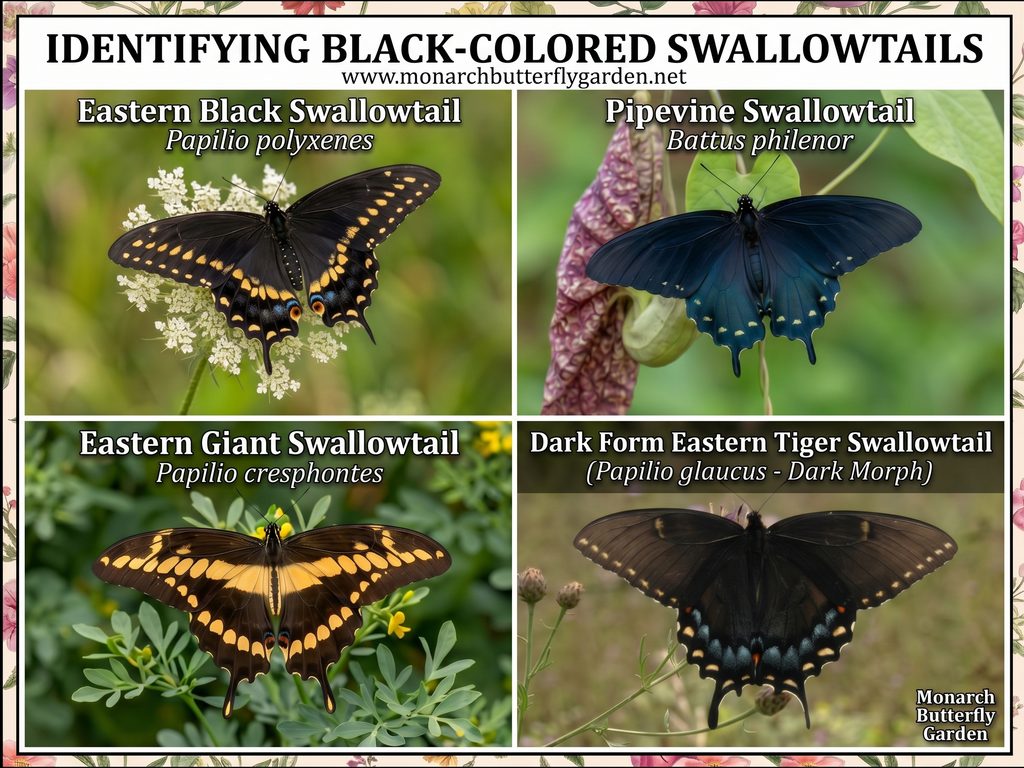
When you spot a black swallowtail, several species will look similar at first glance. This short guide focuses on five dark-colored swallowtails you may encounter in the garden and provides clear identification points that can help you correctly identify them in your garden.
Quick ID Checklist for 5 Black Butterflies
- Are the wings uniformly dark or do they have contrasting bands/spots?
- Do hindwings have tails and how long are they?
- Can you get a ventral (underside) view of the butterfly?
- Are there rows of colored spots (blue, orange, yellow) on the hindwing?
- What caterpillar host plants are nearby (where butterflies lay eggs and caterpillars feed on)
- What is the overall size and flight style?
5 Different Black Swallowtail Butterflies
1. Eastern Black Swallowtail (Papilio polyxenes)
- Upper Wings (Dorsal): Features two distinct parallel rows of bright yellow spots sweeping across both the forewings and hindwings. Females display a powdery blue patch between the yellow rows on the hindwing.
- Key Field Mark: Look for the orange eye-spot near the lower inner corner of the hindwing—it contains a centered black pupil.
- Key Field Mark 2: abdomen lined with two longitudinal rows of yellow dots
- Underside (Ventral): Shows two parallel rows of orange spots separated by a band of iridescent blue.
- Short, pointed tails
- Host plants for butterfly eggs and caterpillars: carrot family (Apiaceae), dill, fennel, parsley, common rue
2. Pipevine Swallowtail (Battus philenor)
- Upper Wings (Dorsal): Deep black forewings contrasted with brilliant, highly reflective electric blue or blue-green hindwings. It features a single row of small white or pale spots along the outer wing margins.
- Key Field Mark: A single, curved row of 7 bright, saturated orange spots embedded in an iridescent blue field on the underside of the hindwing.
- Body: The abdomen features white spots against a dark background (unlike its mimics, which have solid dark bodies).
- Host plants for butterfly eggs and larvae: Woolly Pipevine (Aristolochia tomentosa), Dutchman’s Pipe (Aristolochia macrophylla), Virginia Snakeroot (Aristolochia serpentaria), and California Pipevine (Aristolochia californica)
3. Eastern Giant Swallowtail (Papilio cresphontes)
- Upper Wings (Dorsal): Deep brown-to-black wings with a prominent diagonal band of large, bright yellow spots crossing from tip to tip.
- Key Field Mark: Yellow submarginal spots form an “X” or “V” shape near the forewing tips, and the tails contain yellow centers.
- Underside (Ventral): Mostly solid butter-yellow underneath, making it unmistakable in flight.
- Host plants for butterfly eggs and caterpillars: Common Rue (Ruta graveolens) and all cultivated citrus trees (Orange, Lemon, Lime, Grapefruit). In warm weather regions like Florida or Central America, the larvae are sometimes considered pests because of their preference for the citrus, but might we suggest…plant more trees!
4. Dark Form Eastern Tiger Swallowtail (Papilio glaucus – Dark Morph)
- Upper Wings (Dorsal): Overall charcoal-black or dark brownish-black ground color.
- Key Field Mark: Faint “ghost” tiger stripes remain visible through the dark forewing scaling when viewed close-up or in direct sunlight.
- Wing Edges: A single row of small yellow submarginal dots lines the outer forewing margin, paired with a band of blue scaling and a single orange crescent on the hindwing.
- Host plants for butterfly eggs and caterpillars: Tulip Tree / Yellow Poplar (Liriodendron tulipifera), Wild Black Cherry (Prunus serotina), Sweetbay Magnolia (Magnolia virginiana), Green Ash (Fraxinus pennsylvanica), Lilac, Willow, Birch, and Cottonwood
5. Spicebush Swallowtail (Papilio troilus)
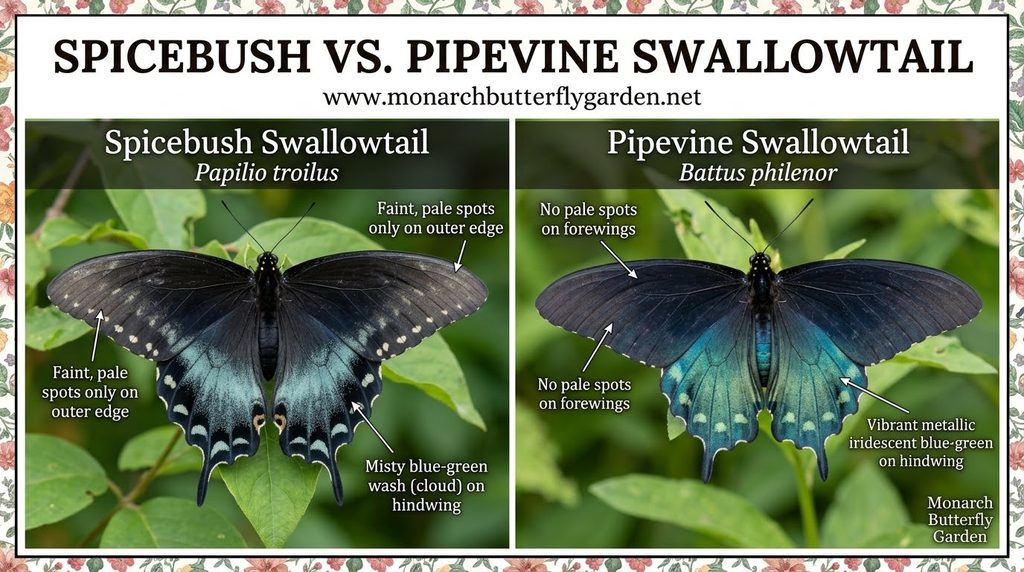
- Upper Wings (Dorsal): Dark blackish-brown wings with a pale blue-green (males) or powdery blue (females) clouding on the hindwings.
- Key Field Mark: Contains a single row of pale greenish-ivory spots along the edge, plus a distinct standalone orange spot on the upper leading edge (costal margin) of the hindwing.
- Underside (Ventral): Displays two rows of orange spots, but the 7th orange spot in the middle sequence is missing and replaced by a blue “comet” streak.
- Host plants for butterfly eggs and caterpillars: Redbay (Persea borbonia), Swampbay (Persea palustris), and Camphor Tree (Cinnamomum camphora)
Next time you see unidentified black butterflies in your garden, refer back to this post to assist your black swallowtail butterfly identification.
What kind of butterflies are black besides swallowtails?
In our midwest region the two most common butterflies we see that have blackish coloration are red admirals (Vanessa atalanta) and red-spotted purples (Limenitis arthemis astyanax).
Mourning cloaks (Nymphalis antiopa) are also dark but more brownish in color.